Why the Best Entertainment You'll Ever Have Is the Kind You Don't Have to Share
Let's be honest for a second. You've been in that situation — everyone's excited about the movie, someone picked the playlist, and you're sitting there halfway engaged, halfway performing enthusiasm you don't quite feel. You laugh when others laugh. You nod. You say "that was so good" on the way out. And then you go home and feel weirdly... empty.
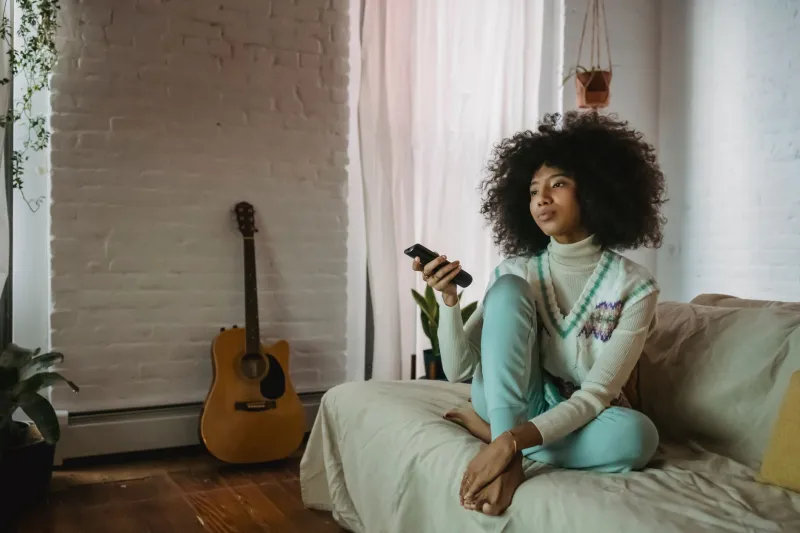
Now flip the script. Remember the last time you put on a show you'd been quietly obsessed with, curled up in your favorite corner of the couch, no one asking questions or checking their phone next to you? That feeling? That absorption? That's not antisocial behavior. That's actually your brain doing something pretty remarkable.
The Science of Watching Alone (It's More Interesting Than It Sounds)
Psychologists have been studying what's called "narrative transportation" for years — basically, how deeply a person can get absorbed into a story. And here's the kicker: the research consistently shows that solo viewing tends to produce higher levels of transportation than group viewing.
Why? Because when you're with other people, part of your brain is always running a social monitoring process. You're picking up on cues, managing reactions, staying relationally present. It's not bad — it's just human. But it means you're never fully in the story. You're splitting your attention between the screen and the room.
When you're alone, that social overhead disappears. You cry when you feel like crying. You pause to sit with a scene that moved you. You rewind because you want to, not because someone else missed a line. The experience becomes entirely yours — and that ownership changes everything about how you process it.
FOMO Is Lying to You (Kindly, But Consistently)
Here's where things get culturally tricky. We live in an era built around shared media moments. Group chats blow up over finales. TikTok stitches your favorite scenes before you've even had a chance to watch them. The implicit message everywhere is: entertainment is better when it's collective.
And sure, there's real joy in that. Watching a Super Bowl ad in a room full of people, or seeing a horror movie in a packed theater — those are genuinely different and worthwhile experiences. Community viewing has its place.
But FOMO has a sneaky way of convincing us that every entertainment moment should be communal. That watching something alone is somehow less valid, or even a little sad. That if you didn't see it with someone, it barely counts.
That's just not true. And more importantly, it's keeping a lot of people from fully enjoying the entertainment they actually consume.
The Friendship Paradox Nobody Talks About
Here's the counterintuitive part: the more intentionally you engage with entertainment on your own, the richer your conversations with other people tend to become.
When you've genuinely absorbed something — when you've let a podcast episode actually land, or sat with the ending of a novel before immediately texting about it — you bring more to the table when you do share. You have actual thoughts. Specific reactions. Real emotional texture to offer.
Compare that to the half-formed impressions you get from half-watching something while chatting. You end up in conversations where everyone's kind of agreeing without anyone really having felt anything. It's connection that skims the surface.
Solo entertainment, done intentionally, is actually relationship fuel. It fills you up so you have something worth giving.
What "Curated" Actually Means for Your Alone Time
This is where we get practical — and where the difference between passive and intentional really matters.
Passive solo entertainment is doomscrolling through Netflix for 40 minutes before picking something mediocre because you got decision fatigue. It's watching three episodes of a show you don't even like because stopping feels like admitting defeat. It leaves you drained rather than restored.
Intentional solo entertainment is different. It starts with knowing yourself well enough to recognize what actually nourishes you — not what you think you should be watching, or what the algorithm keeps serving up, but what genuinely makes you feel something. Maybe that's prestige drama. Maybe it's vintage comfort TV. Maybe it's a deeply nerdy documentary about 18th-century cartography that no one else in your life would survive for ten minutes.
The curation part matters. When you treat your solo entertainment like it deserves a little thought and intention — the same energy you'd put into planning a dinner or a workout routine — the quality of those experiences goes up significantly.
Permission Granted
If you need someone to say it: it is completely okay to not want to watch things with other people sometimes. It is okay to protect certain shows, albums, or books as yours. It is okay to decline the group watch party because you already started the series alone and you don't want to give that up.
You are not being antisocial. You are not being precious. You are recognizing that some experiences are better when they're not diluted by the social performance layer we bring to every shared moment.
There's actually a term for the things we keep just for ourselves — psychologists call them "self-expanding experiences," moments that grow our sense of who we are and what we're capable of feeling. Solo entertainment, when it's intentional, does exactly that.
Finding Your Version of This
Not everyone's solo entertainment sweet spot looks the same, and that's kind of the whole point. For some people, it's a Sunday morning ritual with coffee and a long-form documentary. For others, it's a late-night playlist that nobody else would understand. For others still, it's a book series they've been slowly working through for months, one chapter at a time, savoring it.
The question worth asking yourself: What would I be watching, reading, or listening to right now if I had no one to answer to?
That answer? That's worth protecting.
Because at the end of the day, the entertainment that actually changes you — that gets under your skin and shifts something — is almost always the kind you experienced fully, without one eye on the room. And that's not a consolation prize for being alone. That's the main event.